
Concrete is the foundation of modern construction — used in everything from skyscrapers and bridges to industrial floors and residential foundations. Yet, even this strong material has a weakness: it performs poorly under tension.
That's why reinforcement is essential. Traditionally, engineers have relied on steel rebar to give concrete the tensile strength it lacks. But now, fiber reinforcement, especially steel fiber and polypropylene (PP) fiber, is transforming how concrete is designed and built.
At LANDU, we provide advanced steel fiber and PP fiber technologies that enhance crack control, impact resistance, and long-term durability — delivering a smarter, more efficient alternative to traditional reinforcement.
Why Concrete Needs Reinforcement
Concrete is excellent in compression but weak in tension and flexure. Under shrinkage, temperature changes, or heavy loading, microcracks appear and can propagate into structural damage. Reinforcement helps concrete resist these tensile forces. Rebar, steel fiber, and PP fiber each improve performance — but in different ways. Understanding these differences allows engineers and contractors to select the optimal system for safety, cost, and efficiency.
What Is Fiber Reinforced Concrete (FRC)?
Fiber Reinforced Concrete (FRC) is a composite material containing small, evenly distributed fibers that improve tensile strength, control cracking, and enhance toughness.
LANDU Steel Fiber
For structural reinforcement and impact resistance
High-Performance Structural Solution
LANDU PP Fiber
For shrinkage control, surface durability, and chemical resistance
Lightweight Crack Control
Together, they form a comprehensive reinforcement solution adaptable to both structural and non-structural concrete systems.
Fiber Reinforced Concrete vs Rebar: Key Differences
Understanding the fundamental differences between fiber reinforcement and traditional rebar helps engineers make informed decisions for optimal project outcomes.
| Feature | Fiber Reinforced Concrete (FRC) | Rebar Reinforced Concrete |
|---|---|---|
| Reinforcement Form | Dispersed steel or PP fibers in mix | Steel bars embedded in concrete |
| Tensile Strength | Moderate to high (depends on fiber type) | Very high |
| Crack Resistance | Excellent micro- and macro-crack control | Limited to stress zones |
| Durability | Corrosion-resistant (especially PP fiber) | Vulnerable to rust |
| Construction Speed | Faster — mixed directly in concrete | Slower — requires layout and tying |
| Cost | Lower labor and total cost | Higher labor and maintenance cost |
| Ideal For | Floors, tunnels, precast, pavements | Bridges, columns, structural beams |
LANDU Steel Fiber — Structural Strength and Toughness
LANDU Steel Fiber is engineered for high-performance structural concrete applications. Made from premium-grade steel, these fibers provide outstanding tensile and flexural reinforcement, improving crack resistance and load-bearing capacity.

High Structural Strength
Increases tensile and flexural strength of concrete, enabling superior load-bearing performance in demanding applications.
Superior Impact & Fatigue Resistance
Perfect for industrial floors, tunnels, and pavements where repeated loading and impact forces are common.
Uniform Stress Distribution
Dispersed reinforcement prevents large crack propagation by distributing stress evenly throughout the concrete matrix.
Reduced Rebar Dependence
In some applications, steel fiber can partially or fully replace rebar, simplifying construction and reducing costs.
Typical Applications:
Bridges, precast elements, industrial floors, airport runways, shotcrete, and tunnel linings.
When combined with LANDU's polycarboxylate superplasticizers, steel-fiber concrete achieves excellent workability and compaction without fiber clumping.
LANDU PP Fiber — Lightweight Crack Control and Durability
LANDU Polypropylene (PP) Fiber provides a non-corrosive, cost-effective reinforcement option ideal for crack control and durability enhancement.
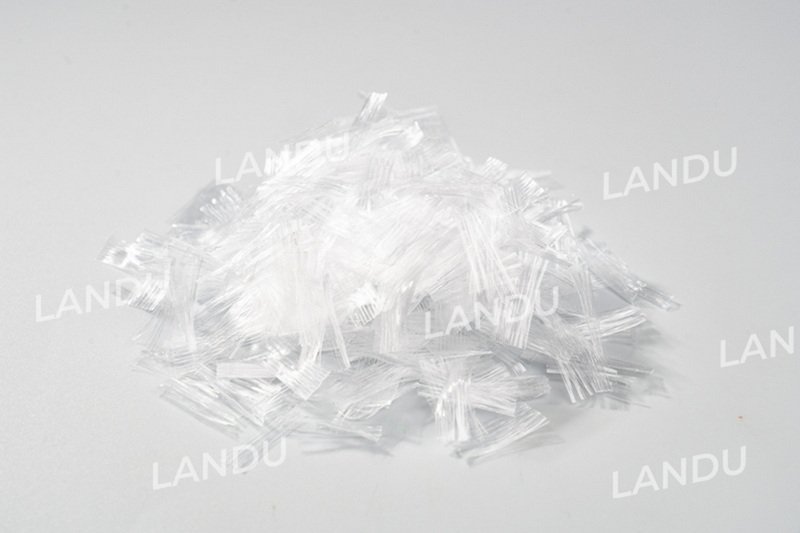
Outstanding Crack Resistance
Prevents plastic shrinkage and temperature cracks by providing three-dimensional reinforcement throughout the concrete matrix.
Non-Corrosive & Chemically Stable
Ideal for humid or chemical environments where traditional steel reinforcement would deteriorate over time.
Easy Mixing & Application
No cutting or tying required, saving significant time and labor costs during construction.
Eco-Friendly Reinforcement
Reduces steel use and improves sustainability while maintaining excellent performance characteristics.
Alkalmazások:
Residential floors, pavements, precast components, waterproof concrete, mortars, and decorative concrete.
When used with LANDU's RDP powders and HPMC, PP fiber improves adhesion, cohesion, and surface finish, ensuring long-term performance.
LANDU Additives: Maximizing Fiber Performance
To achieve the best results, fiber reinforcement must be paired with optimized concrete chemistry. LANDU offers a full range of concrete additives to enhance fiber dispersion and matrix bonding:
Polycarboxylate Ether (PCE) Superplasticizers
Improve fluidity and strength while maintaining low water content for optimal fiber dispersion.
Powder Defoamers
Reduce entrapped air and enhance surface density for improved concrete quality.
Redispersible Polymer Powders (RDP)
Boost adhesion and flexibility, creating stronger bonds between fibers and concrete matrix.
HPMC & HEC
Improve water retention and workability, ensuring consistent fiber distribution throughout the mix.
Together with steel and PP fibers, these admixtures deliver reinforced concrete systems that meet the highest standards of strength, workability, and durability.
Why Choose LANDU for Fiber Reinforcement?
As a professional manufacturer of construction chemical additives and fibers, LANDU combines scientific innovation with practical experience to deliver customized reinforcement solutions.
Advanced Production Technology
State-of-the-art manufacturing facilities for both steel and PP fibers ensure consistent quality and performance.
Excellent Fiber Consistency
Superior dispersion characteristics guarantee uniform reinforcement throughout your concrete mix.
Technical Guidance
Expert mix design support and application consulting to optimize your project outcomes.
Comprehensive Additive System
Complete range of compatible admixtures for maximized fiber performance and concrete quality.
Whether you're reinforcing concrete for industrial, infrastructural, or residential applications, LANDU helps you achieve superior performance with reduced costs and faster construction.
Building the Future with LANDU Fiber Reinforcement
In the debate between fiber reinforced concrete vs rebar, the right answer depends on project goals — but the future is clearly moving toward fiber-enhanced systems.
✅
Higher strength and toughness
✅
Improved crack resistance
✅
Faster, more economical construction
✅
Long-term durability and sustainability
Supported by LANDU's advanced chemical additives, our fiber solutions are redefining concrete performance worldwide — from high-rise structures to industrial flooring.
Build smarter. Build stronger. Build with LANDU.
Következtetés
Fiber reinforcement technology represents a fundamental shift in how we approach concrete construction. While traditional rebar will always have its place in heavy structural applications, the versatility, efficiency, and performance benefits of fiber reinforced concrete are undeniable.
LANDU's Steel Fiber and PP Fiber solutions provide engineers and contractors with powerful tools to create concrete structures that are stronger, more durable, and more cost-effective than ever before. Whether used independently or in hybrid systems, these advanced reinforcement technologies deliver measurable improvements in crack control, impact resistance, and long-term performance.
Ready to revolutionize your concrete reinforcement strategy? Contact LANDU's technical team today to discover how our fiber solutions can optimize your next project.
 Magyar
  English
  العربية
  Deutsch
  Português do Brasil
  Español de Perú
  Français
  Русский
  Italiano
  Türkçe
  Suomi
Suomi  Nederlands
  한국어
한국어  日本語
日本語  Português
  Български
  Čeština
  Dansk
Dansk  Ελληνικά
  Eesti
Eesti  Bahasa Indonesia
  Lietuvių kalba
  Latviešu valoda
  Norsk bokmål
  Polski
  Română
  Slovenčina
  Slovenščina
  Svenska
  Українська